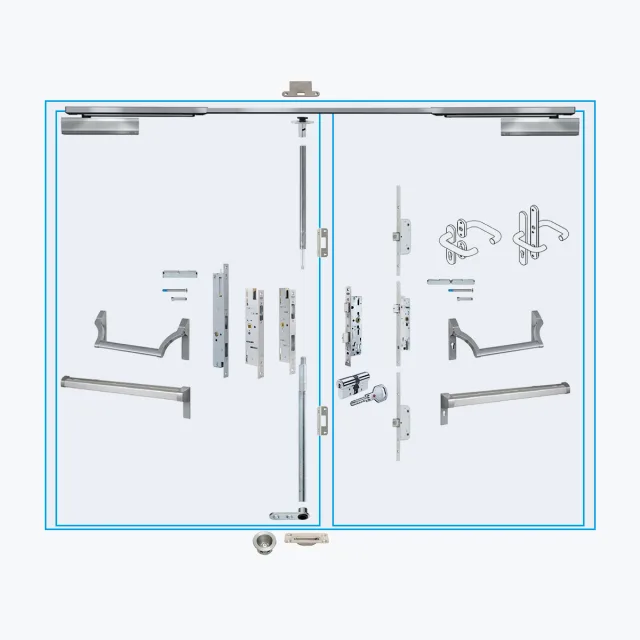
Anti-panic hardware - general information
What is an anti-panic hardware?Anti-panic hardware are special devices installed on evactuation doors that allow simple and secure opening of the door from the inside of the building according to the direction of evacuation of people in the corridors or staircases, regardless of the block and locks that prevent the door from being opened from the outside. What does an anti-panic lock rely on?Anti-panic locks are constructed in such a way that unlocking from the inside is possible when pressing a special lever. This type of lock fulfills its role when it allows an almost immediate exit from the building - realeasing the door shouldn't take more than a second. When do we use anti-panic handles?Doors that are an evacuation exit from a room, in which more than 300 people can be at the same time, and doors on an evacuation path from that room should be equipped with anti-panic devices. How does an evacuation door operate?The most characteristic element of anti-panic closings is a pressure bar or a pressure strip, which replaces a traditional handle. Doors with such a lock should always open when pressure is put on the bar or strip.
Each of the anti-panic locks is characterized by the fact that, from the inside, it will allow you to leave the place after pressing the handle or panic lever. It doesn't impact the lock-closing state. A special construction of the lock forces unlocking, but only from the inside (it will allow you to leave). Anti-panic hardware is used in PCV, aluminum, wood, and steel joinery. There are two: paving and recessed (hidden). Paving hardware - the whole hardware is installed on the surface, which means that all locking elements along with steering elements (handles, knobs, bars, etc.) are visible. Recessed hardware - that means that the closing parts (single-point locks, door bolts) are mounted in the fitting groove of the sash and the locking point in the frame's groove. Only steering elements remain visible, i.e., handles, knobs, and bars. There are two hardware norms: