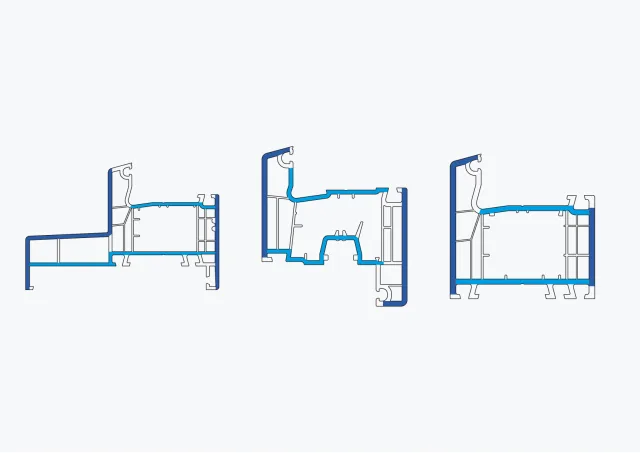
PVC Profile classes
Profile classes - In accordance with the applicable standards EN 12608: 2004, each PVC window profile belongs to the appropriate class. Particular classes differ from each other in terms of the thickness of the visible and invisible profile walls.
VISIBLE WALLS OF PROFILES ARE MARKED WITH NAVY BLUE COLOR For A class, the minimum thickness is ≥ 2.8 mm. For B class, the minimum thickness is ≥ 2.5 mm. For C class, there is no standard for the minimum thickness of visible wallsINVISIBLE WALLS ARE MARKED WITH BLUE COLORFor A class, the minimum thickness is ≥ 2.5 mm. For B class, the minimum thickness is ≥ 2.0 mm. For C class, there is no standard for the minimum thickness of invisible walls
Nevertheless, in addition to the above classification, there are a number of other parameters that are required to obtain the proper quality of window profiles. The standard precisely specifies the testing methodology and requirements for products in the following scope:
AppearanceDimensions and accuracy (other than just wall thickness)Straightness deviationsProfile weight of 1 meterVicat softening pointDimensional stability at + 100 ° CTemperature resistance + 150 ° CImpact resistance at -10 ° CImpact strength using the Charpy methodShock tensile strengthModulus of elasticity in bendingStrength of welded cornersand finally -Thickness of walls visible and invisible in sections (profile class)
Class A vs Class B - see FAQ p.13 for comparison
The class of PVC profiles is therefore only one of the many requirements for window profiles and relying only on this indicator is a wrong approach, often used by manufacturers as a sales gimmick.