Rw - Weighted Sound Reduction Index
What is the Rw coefficient?
A Weighted Sound Reduction Index or Rw, is the rating used to measure the level of sound insulating abilities of windows. It is expressed in. It is expressed in decibels - dB. The higher the value of the Rw coefficient, the better the acoustic insulation of the window and, consequently, the better soundproofing of the room.
How does it work?
Standard windows have an Rw coefficient of around 30 dB. This means that the outside noise will be reduced by these 30 dB. Take, for example, a window with a standard, single-chamber pane of 4/16/4 construction (how to read the glass markings you can check here), with an Rw of 33 dB. If the noise outside the window is 72 dB (e.g. a passing car), the window will reduce the noise inside the room to 39 dB, i.e. by less than a half.
Acoustic insulation of the glazing unit and Rw of the entire window
It is worth mentioning that although the Rw of the applied glazing unit has a significant impact on the insulation of the entire window, these indicators are not the same. The acoustic insulation of the glazing unit applies only to a composite glass with specific dimensions, tested in laboratory conditions. The acoustic insulation of the window takes into account not only the glazing used, but also the size of the structure and other components such as profiles, air inlets or thresholds.
Correction for various types of acoustic spectrum (C and Ctr)
Until recently, the acoustic insulation of a given window was assessed only on the basis of the Rw index, thus disregarding the characteristics of the noise source. This resulted in inaccuracies and, as a result, customer dissatisfaction as to the level of noise attenuation by the joinery.
To avoid confusion, a uniform indicator Rw (C; Ctr) has been developed. The letters "tr" in the coefficient designate come from the word traffic. The Ctr(dB) correction is used for noise sourceslow frequency, e.g. constant traffic, planes in the distance, slow rail traffic. Correction C (dB) is used for high-frequency noise sources, e.g. high-speed traffic, high-speed rail traffic, passing airplanes, human speech. Corrections are calculated on the basis of weighted acoustic spectra: Ctr = A-weighted urban traffic noise spectrum - e.g. the sound of slowly passing vehicles (constant noise)C = A-weighted pink noise spectrum - e.g. aircraft noise, sounds of fast moving vehiclesBoth of the above-mentioned corrections are usually negative numbers and their application means that an excessively favorable value of the sound insulation will be corrected downwards. The C and Ctrindices are calculated by measurement laboratories and appear next to the Rw sound insulation value, e.g. Rw (C; Ctr) = 37 (-1; -3)This means that the sound insulation of the same window depends on the frequency of the noise source. The Ra2 index is used to define the acoustic requirements for street noise (most often found in design documentation), where Ra2 = Rw + Ctr. So in the example above:
Rw (C; Ctr) = 37 (-1; -3)
The weighted value of Rw is 37 dB, but with regard to traffic noise, this value is reduced by 3 dB:
Rw = 37 dBRa2(which is Rw + Ctr) = 37 + (-3) = 34 dB
<!--td br -->
Including a correction for spectrum C, i.e. noise from a nearby airport, for example, is expressed as Ra1, where Ra1 = Rw + C and again, back to the example above:
Rw = 37 dBRa1 (which is Rw + C) = 37 + (-1) = 36 dB
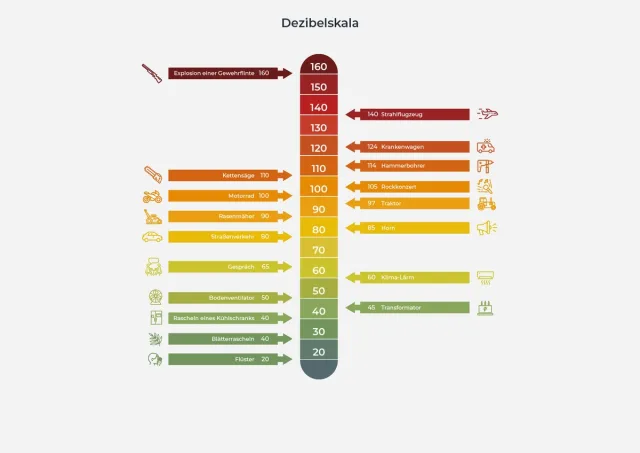
The decibel scale
The level of perception and sensitivity to noise is a very individual matter, but it is generally accepted that:
<!--td br -->
<!--td br -->
range 0 - 35 dB - is harmless, may be slightly irritating36 - 75 dB range - may cause irritability and fatiguerange 76 - 85 db - in case of constant exposure, causes headaches, weakens mental performance and hearingrange 86 - 135 dB - significantly damages hearing, can lead to imbalances and disorders of the nervous and circulatory systemsIt is also worth mentioning here that the perception of sounds is not linear, because the reduction of sound intensity by:1 dB is practically inaudible to humans3 dB is already audible5 dB is perceived as a noticeable improvement10 dB is perceived as reducing the noise by half The graphic below presents a few selected sources of noise and its intensity: Which window should I choose?<!--td br -->First of all, it is absolutely necessary to take into account the volume of traffic and objects in the neighborhood of the building. It is assumed that:<!--td br --><!--td br --><!--td br </span>--><!--td br {mso-data-placement:same-cell;</span>-->
windows with average noise insulation should have an Rw index of 33 dBwindows with good noise insulation should have an Rw index of 40 dB; Ra2 = Rw + Ctr = 40 + (-4) = 36 dBwindows with very good noise insulation should reach Rw at a minimum level of 45 dB; Ra2 = Rw + Ctr = 45 + (-3) = 42 dB