Soundproof glazing
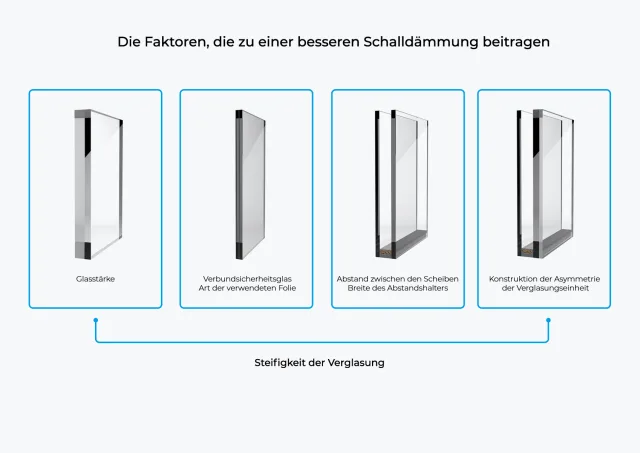
Windows with increased sound insulation parameters are equipped with soundproof (sound-absorbing) glazing. Such panes are characterised primarily by their increased thickness. The thickness of glass in standard double-glazed units is 4-6 mm, 4-8 mm or 6-10 mm. In soundproof panes, the space between the panes has been increased and the empty space filled with noble gas. This is why they are called glass units because they consist of two or more panes separated by a spacer bar.
Soundproof glass units are characterised by combinations of specialised and flexible foil. They can be made of ordinary, tempered or laminated glass. To reinforce soundproofing for connecting two (or more) panes, PVB is used, a polyvinyl butyral chemical compound with high material bonding properties. In the spaces between the chambers of the glass, a chemical compound with sound dampening properties is used. For this purpose, noble gases such as krypton, xenon or argon are used, which are characterised by good sound insulation.
To ensure that sounds of different frequencies are effectively muffled, at least one of the glass should be at least half as thick, so that an improvement of up to 5 dB of attenuation can be achieved in each window. In addition, at least one glass pane with a thickness of at least 6 mm should be used, as well as a glass pane with different elasticity, taking advantage of the attenuating properties of bonded glass. Glass units used in the building industry can achieve a sound insulation value of Rw>51 dB. For more on sound insulation rates, see the product tutorial.
It is assumed that, depending on the structure, glasses achieve a weighted insulation index. Insulation indices are tested by specialised laboratories.